When the drummers were Women
a spiritual history of rhythm
Book by Layne Redmond
![]()
A review of Layne Redmond’s book by George Franklin
a spiritual history of rhythm
Book by Layne Redmond

A review of Layne Redmond’s book by George Franklin
In the book, "When the Drummers Were Women" Layne Redmond traces the centuries-long tradition of sacred drumming in Mediterranean cultures.
For hundreds of years, the spiritual life of many of our ancestors revolved around veneration of Mother Goddesses through dance and music. Flutes, harps and most of all hand drums were women's essential parts of sacred ritual.

Egyptian procession. Female percussionists 1225 B.C.
Women had a primary especially role as priestesses and as drummers in drawing people into intimate communion with the Goddess.
Hunting, fishing and agricultural societies were intimately aware of the rhythms of nature: the turning of the seasons, the cycles of the moon and its relation to tides, and the migrational patterns of animals on whom they depended their livelihood. The rythm of women‘s menstrual cycles may have especially attuned them to natural rhythms.
Did sacred drumming begin as an imitation of the heart's pulse?
A pattern known from a mother's womb was echoed by the beating of the priestesses frame drums.
MYTHIC ORIGINS OF DRUMMING
In every Mediterranean civilization I studied, says Redmond:
“It was a Goddess who transmitted to humans the gift of making music. In Sumer it was Inanna; in Egypt, Hathor; in Greece, the nine-fold Goddess called the Muses."
In each o f these cultures, drumming was used both to invoke the Goddess and to enter into a trance state where in humans could hear and channel divine energy.
The rhythm of the frame drum was also a way priestesses made contact with the spirit world. The moon-shape of the frame drum suggests a connection with cycles of death and rebirth akin to the phases of the moon.

In the Mesopotamian city of Ur, the new moon was believed to descend into the underworld. Its resurrection was facilitated by drumming.
In the Near Eastern story of Inanna's descent and return to the underworld, the Goddess remains in the land of the dead for three days and nights — roughly the time of the new moon. And it is the beating of a drum by Ninshubar which initiates Inanna's journey back t o the land of the living.
Variations o f the story of Inanna's descent recurred in almost every subsequent Mediterranean culture. It is found in myths associated with Isis and Osiris, Cybele and Attis, Aphrodite and Adonis, Demeter and Persephone, Ariadne and Dionysos. In each o f these traditions, the frame drum played a pivotal role in the sacred rites.
DRUMMING IN ANCIENT CULTURES
In many ancient Mediterranean cultures, prayer was an active, trance-inducing combination of chanting, music and dance.
A shrine painting at the ancient site o f Catal Hüyük (in modern Turkey) shows a group of dancers clothed in leopard skins, one of whom seems to be playing a small framedrum.
This painting, from c. 5800B.C., is the oldest known depiction of a drum.
Frame drums appear in Egyptian art from at least the reign of Amenhotep III (1417-1379B.C.). Thanks to the unique desert climate of Egyptian tombs, decorated skinheads from some drums have survived.
Two skins from the New Kingdom (c.1600-1100B.C.) show Isis giving life to Osiris, linking the drum to creation and resurrection myths.
Priestesses are also shown in Egyptian art playing the frame drum to accompany divine processions.

Priestesses of Dionysos, C. 420 B.C.
Although Egypt was by this time a patriarchal society, drumming appears still to have been partly in the hands of women. When the sun God made his daily way across the sky, women are depicted setting the rhythm for his journey with frame drums.
Around the same time, the island civilization of Crete was the site of a strong Goddess-oriented culture. The Goddess Rhea (later known as Ariadne in Greek myth) sat before a sacred cave playing on a brazen drum, compelling attention to the oracles o f the Goddess.
In later Greek versions of her story, Ariadne is the Goddess of the labyrinth. To enter the labyrinth, Redmond suggests, "is to experience a ritual death; to escape from it is to be resurrected." The story of Ariadne giving Theseus a ball of thread to guide him back out ofthe labyrinth is well-known.
Redmond draws a fascinating parallel with shamanistic ritual, in which "the beat of the drum is the thread guiding the shaman back to the natural world..." It is hardly a coincidence, then, that Ariadne is often shown playing a frame drum.

GREECE AND ROME
As we move on to ancient Greece and Rome, the last of the pre-Christian Mediterranean cultures, we are squarely in the realm of patriarchy.
Nevertheless, many elements of Goddess worship and ritual survive in these cultures.
Cybele, adopted into Greek religion from the Near East, was considered a source of prophecy in Greek times.
Her prietesses used drums and flutes to enter into a receptive trance and hear Her divine revelation.
Around 200 B.C., Cybele was also adopted as a protectress of the city of Rome, where her flamboyant followers shocked the staid Roman patricians.
The popularity of Cybele's cult opened the way for the mystery religions that flourished in the Roman Mediterranean during the early A.D.centuries.
These mystery schools were often adapted from older practices of Near Eastern origin.
One of the best known was that centering around Eleusis, near Athens. Dating back to at least 1200 B.C., the Eleusinian Mysteries carried Goddess worship into later times. It is Persephone, not a male deity, who travels to the land of the dead and must be recalled - like Inanna, by the playing of a frame drum.
DECLINE AND REDISCOVERY
Sacred drumming, associated with pre-Christian religions (lumped together as "pagans" by later writers), declined after Christianity became the official state religion of the Roman Empire in the 4th Century A.D.
Yet the image of women drummers survived. As we approach the new millenium, women are once again becoming powerful drummers and leaders of spiritual movements.
The closing chapter o f Redmond's book documents this development and the hope this carries for transforming our society.
The author, Redmond tells the tale of how she was led into the world of drumming and how, for her, it seemed like it was considered a masculine profession.
Until she discovered that, in ancient times, all percussionists were women.
“For generations, women have carried the memory of silence in their bodies — in the tightening of the throat, the ache of the womb, and the fear of being seen in their truth.”
Olivia W.
Earth, Ritual Drum & Voice workshop
With Rosy KantuIn this workshop you will restore the sacred connection between womb and voice, awakening your ancestral power.
Singing and expressing your voice is a way to know yourself and to support you in a healing process.
Connect with your voice, the cosmos, the internal and external movements.
Discover how to connect with your drum, with rhythm and develop a personal practice.
Singing is our medicine, a practice to remember that we are the Earth.
• Meditation, breathing exercices
• Body earth connection
• Exercises to free your voice
• Movement, embodiment and voice
• Voice is breathing
• Drum, beat of the earth, beat of the heart
Drumming to reestablish your rythmic link with nature
Woman, you are here restoring beauty, femininity and the returning to wholeness through your healing.
Your voice is your medicine

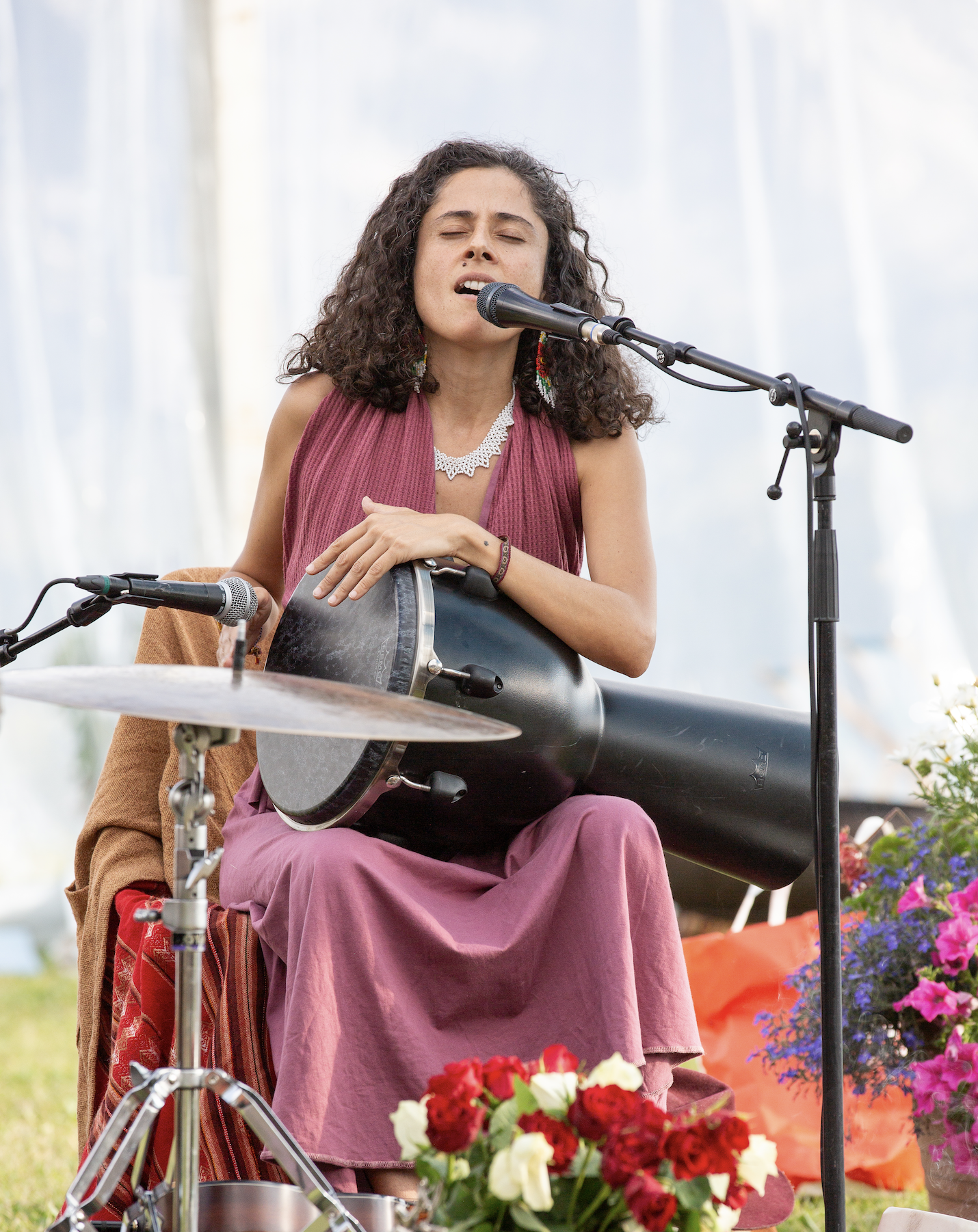
Rosy is a Peruvian artist and musician. She has many playing percussion, and has been leading retreats and workshops for the last 8 years. Her latest song release is ‘Sagrada Luna’.
Deep connected with the Andes and Amazonas, from where she has inspiration for her Music & Arts. Rosy has a deep connection with the native cultures of Peru, studying indigenous traditions. She investigates ancestral techniques of weaving, painting and singing as a sacred connection with the Earth.
She has a strong feminine connection accompanying woman to awake the feminine strength, studied the course of Doula, Natural Birth with Leonie Lange -partera tradicional- in the mountains of Cuzco, Peru. She received a powerful initiation in the "Moondance" in Switzerland, sacred Dance that brings together women from all over the world, rooted in the Mexica traditions. She expresses her visions through her music, “The Song of the Earth”, Women's circles, one-on-one coaching. Facilitates gatherings, ceremonies, concerts and workshops.
Listen to Rosy's music here:
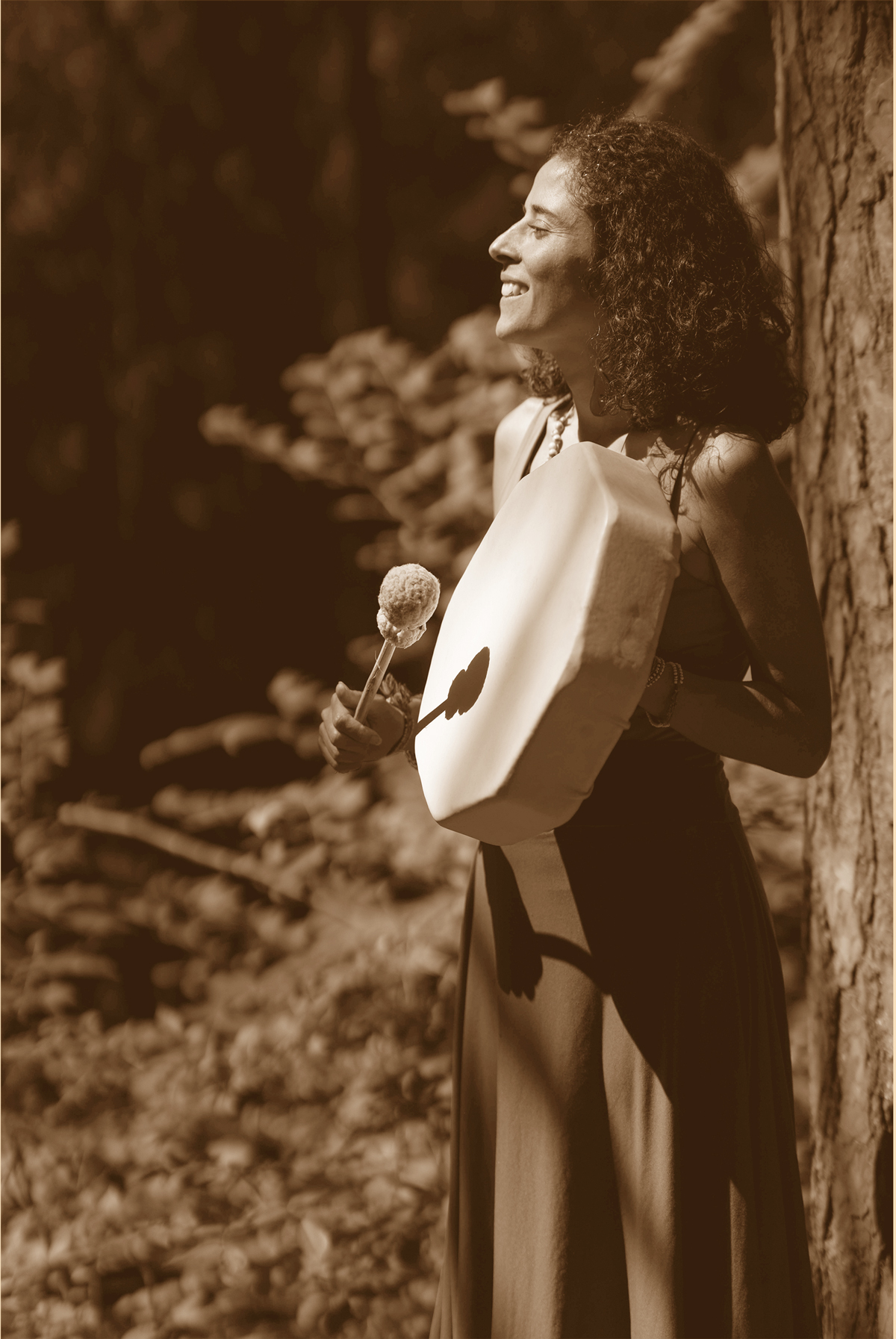
Bring your Drum. No previous experience is required
Language: English
Questions: rosyjs@gmail.com
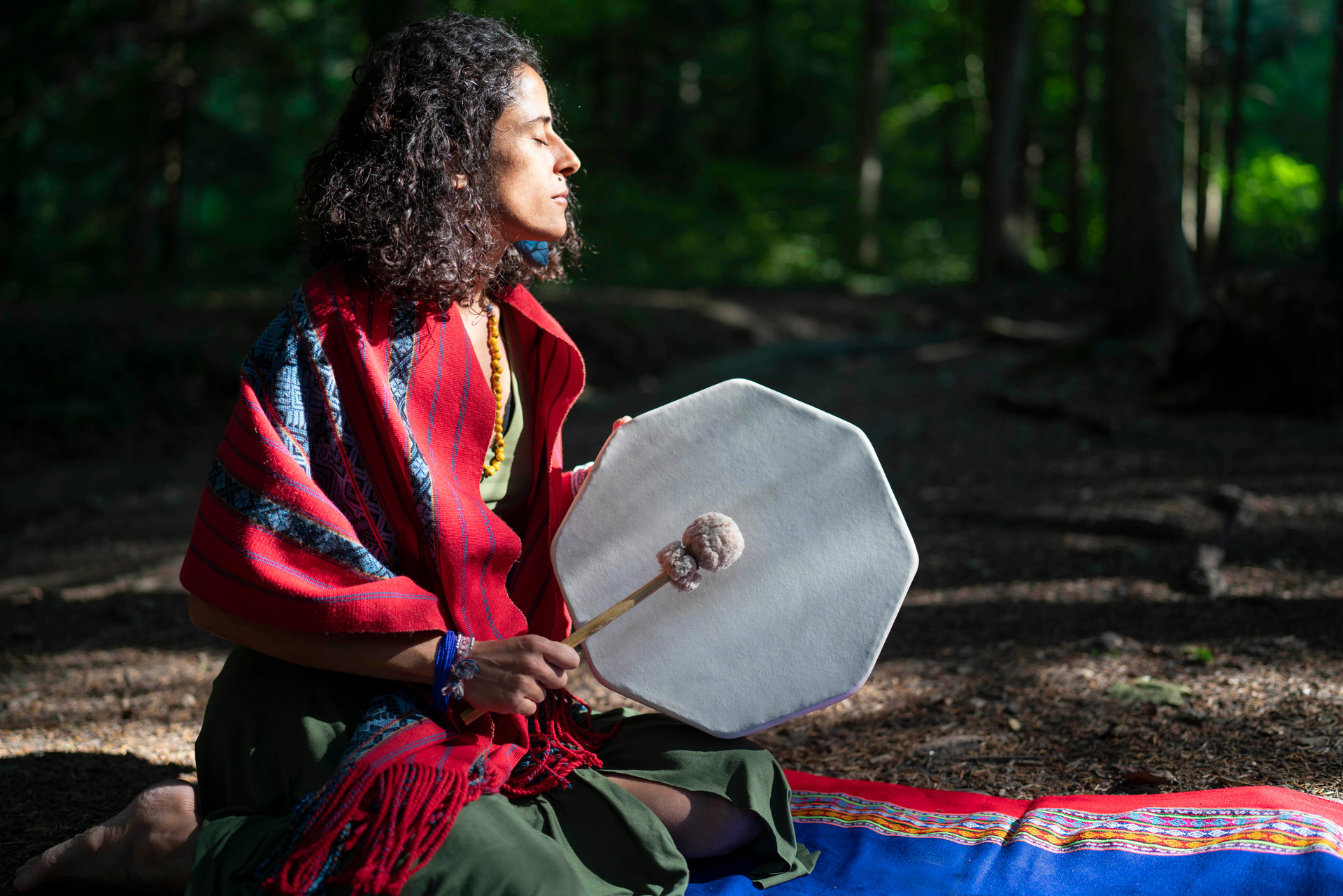
The liberation of the femenine voice
words from Ayla Schafer
words from Ayla Schafer
While we are women who carry ancient legacies of love and medicine,
we are also the daughters of generations of silence, shame, unworthiness, and fear of our voice, our power, and our magic.
We hold both the wound and the medicine in our bodies.
I believe that the wounds are truly the doorways to our deepest, most profound liberation and reclamation.
They are guiding us straight to the source of our ancestral, wild feminine medicine.
If you are reading this...
You are being invited into choosing to be the woman who breaks the spell
of suppression and amnesia around her power, her womb wisdom, and her voice.
There have been centuries where women learned, in very real ways, that it was safer not to speak.
And so they did what they needed to do to survive.
They swallowed their truth.
They buried their rage, their grief, their despair.
They silenced the disappointment of abandoned dreams and repressed desires.
They quieted their voices.
It lives in the body of the lineage… which is the body you are inhabiting now.
It lives in the nervous system. In the instinct to hold back.
In the moment you feel something deeply in your body… and still say nothing.
The fear of your power, the distrust of your womb and intuition, the blockage you feel in your throat are not just yours. They are intergenerational imprints of silence. Patterns learned for survival and passed on, body to body, woman to woman.
But underneath that fear there is also an ancient well of wild feminine wisdom waiting to be unearthed.
A voice that is not fragile, but powerful, intuitive, and clear.
Your voice is not something you have to “find”.
It is something you are here to reclaim and remember.
It is ancestral medicine and it is your birthright.
And when a woman reclaims access to her body, womb and truth, she is healing what her foremothers could not.
She is speaking for her foremothers who could not.
For the women who lived and died without ever being able to name what was true to their soul.
For the women who held their medicine in silence. Who carried their knowing alone. And when a woman liberates her voice from fear, she liberates them too.
She releases the shame. The hiding. The quiet, powerful, ancestral + survival-based oath to stay small.